
Nativity Scene Tour: Where to Find Christmas Nativity Scenes in Munich
“Kripperlschaun” is a Christmas tradition and a popular custom in Munich as well. There are many places in downtown Munich where you can view the impressive scenes from the Nativity story, and we’ll highlight the most beautiful ones.
The Münchner Stadtkrippe and the Oberammergauer Großkrippe
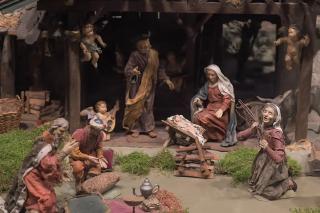
The "Münchner Stadtkrippe" (Munich City Nativity Scene), created in 1953 by the Munich painter and sculptor Reinhold Zellner (1905–1990), is a major attraction in the Prunkhof of the New City Hall—and not just for nativity scene enthusiasts. This traditional Bavarian Christmas nativity scene, featuring 23 human figures and 28 wooden animals, draws its charm from the contrast between figures dressed in Oriental attire and shepherds in Alpine traditional dress.
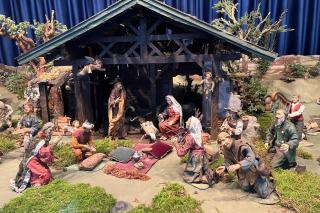
On Marienplatz, at the corner of Rindermarkt near the Kripperlmarkt, you’ll find the Oberammergauer Großkrippe (Oberammergau Grand Nativity Scene), created by the Munich Nativity Scene Enthusiasts Association (Münchner Krippenfreunde e.V.). The renowned Oberammergau woodcarver Georg Lang crafted the nearly life-size wooden figures for this nativity scene.
The Kripperlmarkt (Nativity Scene Market) at the Old Peter's Church
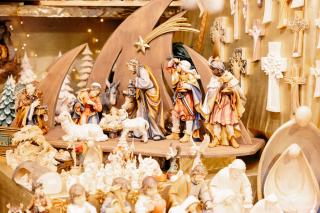
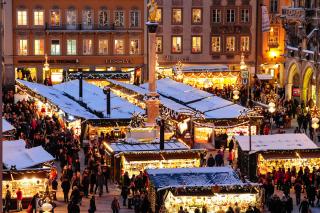
At the Kripperlmarkt, right next to the Alter Peter, the stalls offer nativity scenes and nativity scene accessories. Just a stone’s throw from Marienplatz—where the traditional Munich Christmas Market, with its old Bavarian charm, unfolds against the romantic backdrop of the neo-Gothic City Hall—lies this unique paradise for nativity scene enthusiasts and those hoping to become one: the Kripperlmarkt at the Munich Christmas Market. The selection is vast and offers something for every budget: large, ornate Oriental nativity scenes, miniature Alpine nativity sets, high-quality woodcarvings from South Tyrol, Oberammergau, and the Ore Mountains, as well as affordable, guaranteed unbreakable nativity figures made of plastic that looks deceptively like wood—ideal for young families setting up their very first nativity scene.
Some nativity scene vendors still craft their own goods—such as stable sets—according to traditional designs, often passed down from generation to generation. The accessories for the stable are created through meticulous, detailed work. From lanterns to straw for the ox and donkey to the gifts of the Three Wise Men, you’ll find everything needed for a genuine nativity scene here. You can find decorative items made from natural materials, such as moss and bark, as well as electric nativity scene lighting suitable for the U.S. Some vendors also offer repair services, restoration work, and custom-made items.
The Kripperlmarkt, first documented in 1757, is a unique feature of Munich’s Christmas Market and is considered the largest of its kind in Germany. This special section has a long tradition and became a separate area in the mid-19th century. It wasn’t until after World War II that the Christmas market and the Nativity Scene Market were reunited. Here, visitors can take their time selecting a piece of Christmas to take home. A reminder of childhood, when the nativity scene, standing next to the Christmas tree, opened up a wondrous world to the young visitor.
The Isarkieselkrippe (Isar Pebble Nativity Scene) by H. J. Weimer
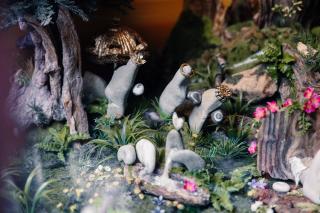
With his Isar Pebble Nativity Scene, also on display in the Prunkhof of the New City Hall, H. J. Weimer combines nature and art in a Christmas-themed composition. The nativity figures are genuine pebbles from the Isar River, shaped by the river over millions of years.
The Münchner Krippenweg (Munich Nativity Scene Trail) in the City Center
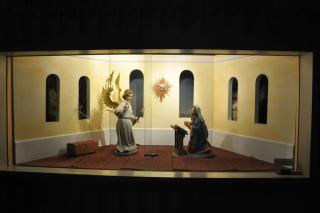
The long-standing association Münchner Krippenfreunde e. V. is launching a special cultural experience this year: From November 29 through January 6, 2027, the Christmas story will be performed every Sunday as a puppet show in the Munich dialect.
The venue is the crypt of St. Theresia Church. For the production, the association has built a stage specifically for this purpose and crafted beautiful, hand-carved figures. The humorous play is suitable for children ages four and up and combines Munich tradition with entertaining puppet theater.
At the same time, a largely redesigned nativity scene exhibition invites visitors to explore its exhibits. It showcases art-historical treasures, including an original 18th-century Munich nativity scene and a valuable Osterrieder nativity scene.
Nativity Scene Collection at the Bavarian National Museum
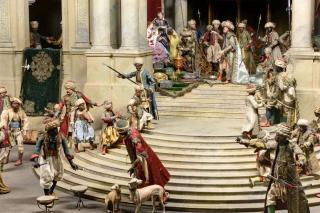
Hardly anyone knows that what is arguably the world’s most significant and artistically valuable nativity scene collection is located in Munich. In addition to figures from Bavaria and Tyrol, the collection also features Christmas scenes from Italy’s most important nativity scene centers.
A highlight of the collection is more than twenty nativity scenes featuring thousands of figures from the collections of the Neapolitan court and nobility, which are characterized by Baroque exuberance and a level of detail that has never been matched since.
The nativity scene collection is open from early November through late January during museum hours.
The Large Nativity Scene at St. Maximilian, Glockenbach District

Graffiti art behind the high altar and even in the large Christmas nativity scene at St. Maximilian. If you look closely, you’ll discover fascinating details in the spacious nativity scene—set up across the corner in the right aisle, directly beneath the Maria Otto Altar with its reliefs depicting the story of Jesus’ childhood—that are arranged to correspond with the progression of the Christmas story.
Furthermore, the colorful, large-scale nativity scene and the other Christmas decorations in the church—such as the Christmas tree made of wooden beams—clearly show that the congregation of the unconventional pastor Rainer Maria Schießler enjoys bringing traditions into the here and now.
During Advent, Mary and Joseph, accompanied by their donkey, are still making their way among shepherds and sheep—and even Roman graffiti on the walls of Bethlehem’s houses. But by Christmas, the scene in the lovingly designed settings shifts from the “search for an inn” to the next biblical scene surrounding the birth of the Christ Child.